
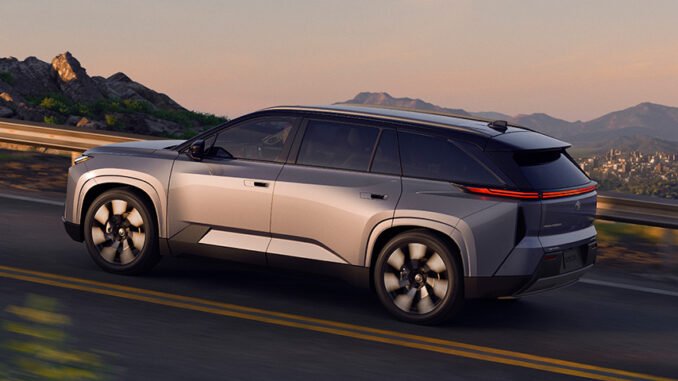
Toyota City, Japan, February 11, 2026―Toyota Motor Corporation (Toyota) announced that it will expand its battery electric vehicle (BEV) lineup in North America as part of its multi-pathway approach toward achieving a carbon-neutral society. As part of this effort, Toyota Motor North America (TMNA), Toyota’s North American business entity, premiered a new BEV model of the three-row SUV Highlander on February 11 (JST; February 10 PST) in Ojai, California. Sales in North America are expected to begin in late 2026.
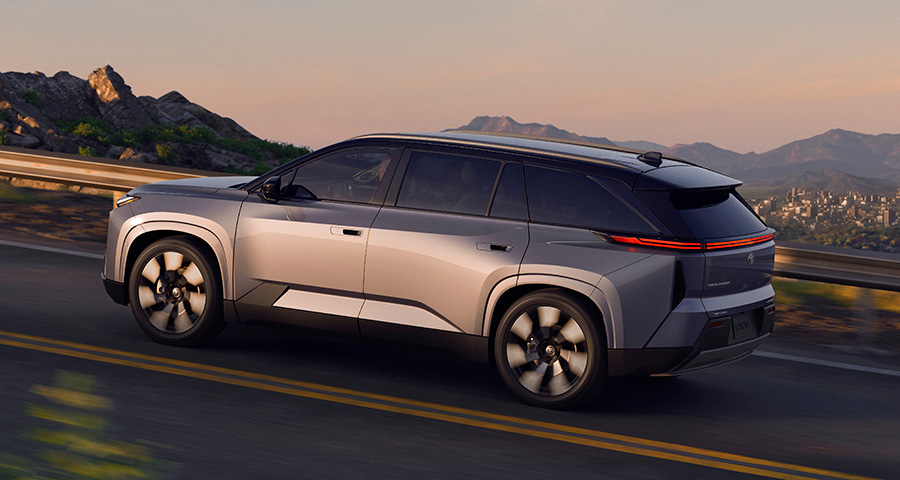
- Highlander BEV (North American model)
Toyota is committed to product- and region-centered management with the aim of making ever-better cars. In developing powertrain systems to achieve carbon neutrality, Toyota is rolling out a variety of mobility solutions under its multi-pathway approach, offering electrified vehicle options tailored to meet customer needs in each country and region around the world.
To steadily advance its multi-pathway approach in the North American market, Toyota will add a BEV model as a key option for the Highlander. Production will take place at Toyota Motor Manufacturing Kentucky (TMMK) as the fourth model in its BEV lineup, following the bZ*1, TOYOTA C-HR*2, and bZ Woodland*3.
| *1 | North American name for the bZ4X |
|---|---|
| *2 | North American name for the TOYOTA C-HR+ (Europe) |
| *3 | North American name for the bZ4X Touring |
Highlander BEV (North American model)
The Highlander has earned strong support from families as a three-row SUV that handles everything from city driving to outdoor adventures, thanks to its spacious interior and excellent off-road performance. Since the first generation launched in the United States in 2001, cumulative sales have exceeded 3.6 million units*4. With the addition of this BEV model, Toyota aims to further evolve the Highlander in its pursuit of a carbon-neutral society.
- The lithium-ion battery lineup includes a 76.96kWh*5*6 capacity specification designed for urban driving, such as shopping trips, and a 95.82kWh*5*6 capacity specification aimed at improving cruising range for customers who enjoy long-distance travel and outdoor activities. Together with front-wheel drive (FWD) and all-wheel drive (AWD) types, a wide range of options are available to customers.
- In addition to incorporating a high-capacity battery and improving eAxle efficiency, the 95.82kWh*5*6 specification has a development target cruising range of up to 320 miles*7 (AWD).
- Battery preconditioning*8 is included, with a development target of rapid charging in approximately 30 minutes*9 under cold conditions by maintaining the battery at an optimal temperature for charging.
Main specifications (development targets) for the Highlander BEV (North American model)
| Driveline | FWD | AWD | ||
|---|---|---|---|---|
| Length | (in) | 198.8 | ||
| Width | (in) | 78.3 | ||
| Height | (in) | 67.3 | ||
| Wheelbase | (in) | 120.1 | ||
| Cruising range | (miles) | 287 | 270 | 320 |
| Battery capacity | (kWh) | 76.96*6 | 95.82*6 | |
| *4 | U.S. cumulative sales, 2001-2025 |
|---|---|
| *5 | Development target |
| *6 | Measured in accordance with IEC standard 62660-1. |
| *7 | Development target value when driving in EPA mode |
| *8 | A function that adjusts the battery temperature before rapid charging |
| *9 | Approximate time required to charge from approximately 10% to 80% of full capacity using a 150kW (350A) rapid charger in an environment with an outside temperature of -10°C. |
Moving forward, Toyota will continue to address customer needs in each region and contribute to carbon neutrality by developing a variety of options―including HEVs, PHEVs, and FCEVs―while striving to make ever-better cars.


Be the first to comment