
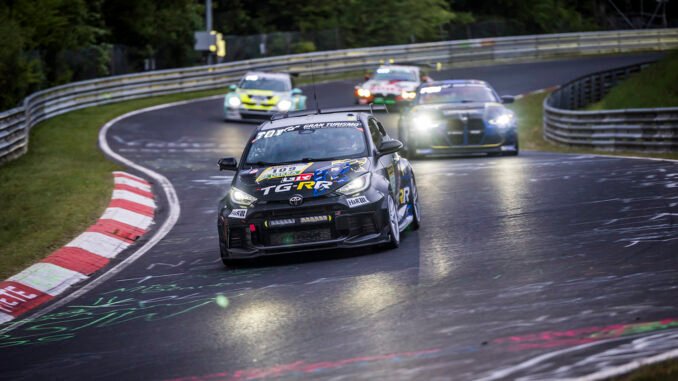
“Things Not Going According to Plan—the True Challenge of the Nürburgring”
The Nürburgring: GAZOO Racing’s roots and an evolving challenge
The 24 Hours of Nürburgring represents GAZOO Racing’s roots and is one of the key activities that symbolizes its commitment to making ever-better motorsports-bred cars.
As in 2025, the team competed as TGRR, formed by the merger of GAZOO Racing and ROOKIE Racing. It featured a crew primarily composed of young engineers and mechanics supported by veterans, serving as a platform for rapidly developing talent through competition.
As in the previous year, the team entered the GR Yaris DAT in a two-car lineup: Car No. 109 and its support car, Car No. 110. The drivers for Car No. 109 were Morizo, Daisuke Toyoda, Hiroaki Ishiura, and Kazuya Oshima, while Car No. 110 was driven by Masahiro Sasaki, who served as Morizo’s lead car driver.
Making ever-better cars by connecting the Nürburgring and Super Taikyu
However, what set this apart from previous efforts is that it did not end with the Nürburgring. The car that competed in last year’s 24 Hours of Nürburgring took part in the Super Taikyu race at Autopolis about a month later. This wasn’t just a triumphant homecoming; it was also a test to see if the GR Yaris that raced at the Nürburgring could hold its own in the Super Taikyu series.
In fact, driving in the hot and humid conditions of Japan, which differ from those of the Nürburgring, provided the team with insights into suspension and engine performance. In other words, this created a cycle of making ever-better cars going back and forth between the Super Taikyu and the Nürburgring.
This also means that the Nürburgring, once regarded as a final test, has become not a finish line but a new starting point, truly embodying the idea that “ever-better car-making is a never-ending pursuit”.
The evolved GR Yaris DAT and development goals
Lead engineer Kei Hisatomi said, “Our mission last year was to test whether the GR Yaris, which we had developed with motorsports as our starting point, could hold its own at the 24 Hours of Nürburgring. Ultimately, we were able to complete the race thanks to the base vehicle’s high fundamental performance, but it’s also true that we hadn’t fully unlocked the car’s potential. This year, we’ve incorporated that experience and those issues into our development. As a result, we’ve taken this year’s Car No. 109 a step further to create an ‘ever-better car’. It’s a forgiving car that inspires confidence even at the limit, combining reassurance and driving enjoyment that make everyone want to drive another lap.”
There are three major points of evolution.
●Powertrain
The specifications were modified around the turbocharger, based on the GR Yaris’s stock G16E engine, with the aim of increasing top speed on the long straights unique to the Nürburgring.
●Aerodynamics and cooling
An under panel and diffuser with improved aerodynamic characteristics were added to further unlock the vehicle’s potential. The shapes of the hood and inner fenders were also modified to balance aerodynamics and cooling.
●Suspension
Although the initial evaluation was positive, the suspension was refined to make an ever-better car and gain new insights. Mounting points were revised, and the geometry and structure of the front struts were modified.
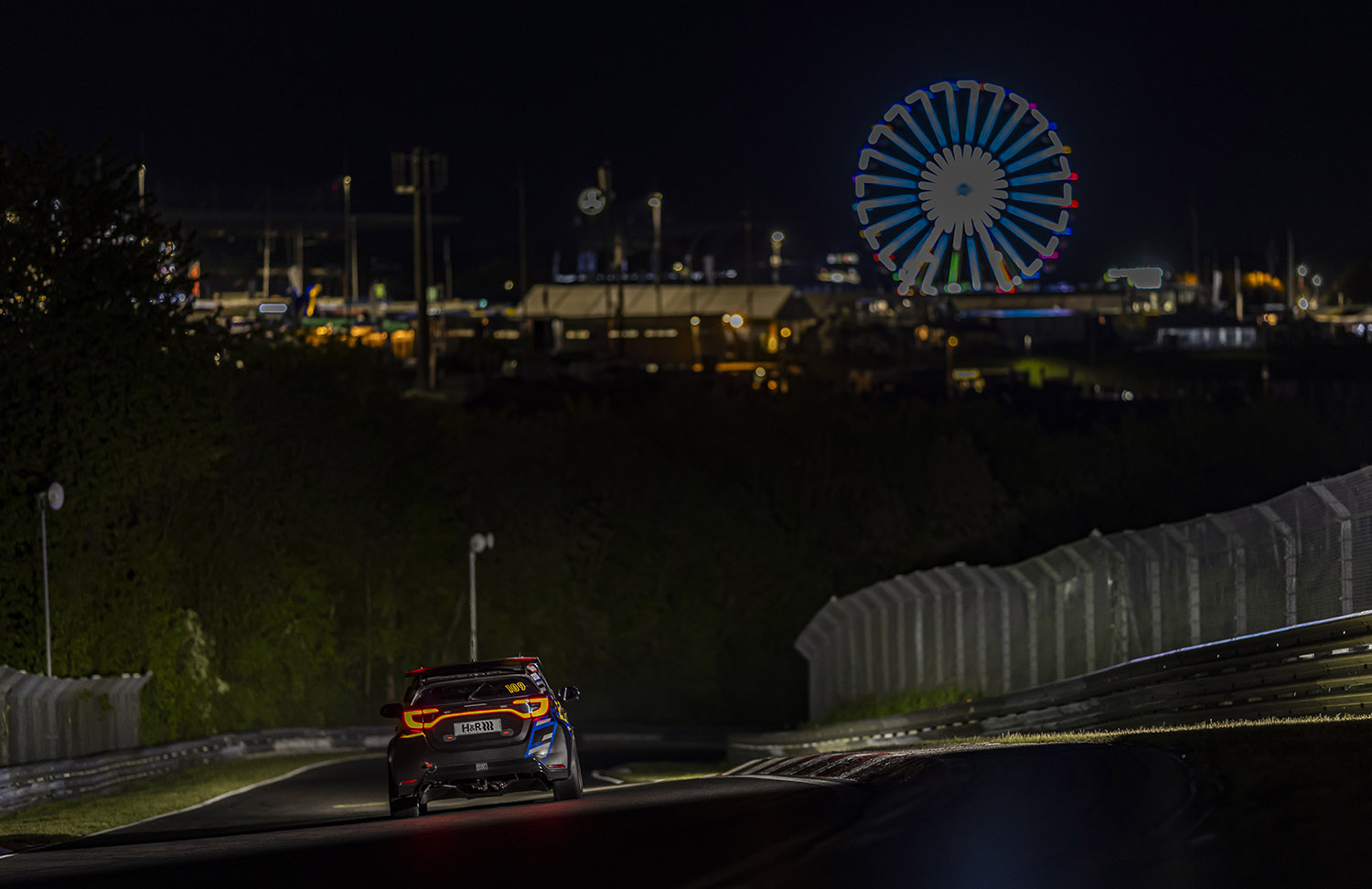
Elsewhere, detailed updates incorporating driver feedback were implemented throughout the vehicle. These included the headlights, an essential element on the Nürburgring at night where there is no external lighting, as well as the instrument cluster and controls. One aspect of car-making that changed from the previous year was a stronger collaborative relationship with other departments. This, too, was one of many unseen changes.
Car No. 110 also had a mission beyond just providing support; as Hisatomi added: “We’ll race Car No. 110 in the exact specification it was in when it ran the 24 Hours of Nürburgring in 2025. This is so we can verify the updates made to Car No. 109 without being misled by changes in track conditions.”
This is proof that this project is being carried out to achieve true next-generation car development.
Following its shakedown in early December 2025, the vehicle underwent meticulous preparation through four test sessions in Japan and participation in the NLS2 in March, where it achieved a lap time approximately 10 seconds faster than last year’s specification. Morizo also made a guest appearance at the opening round of the Super Taikyu series (Motegi) in March driving the GR Yaris DAT Racing Concept (Car No. 104) for GR Team SPIRIT. The GR Yaris DAT competing in the 24 Hours of Nürburgring and Car No. 104 competing in the Super Taikyu series are exchanging technology and know-how, and this was also part of the development testing.
The stage for the decisive battle
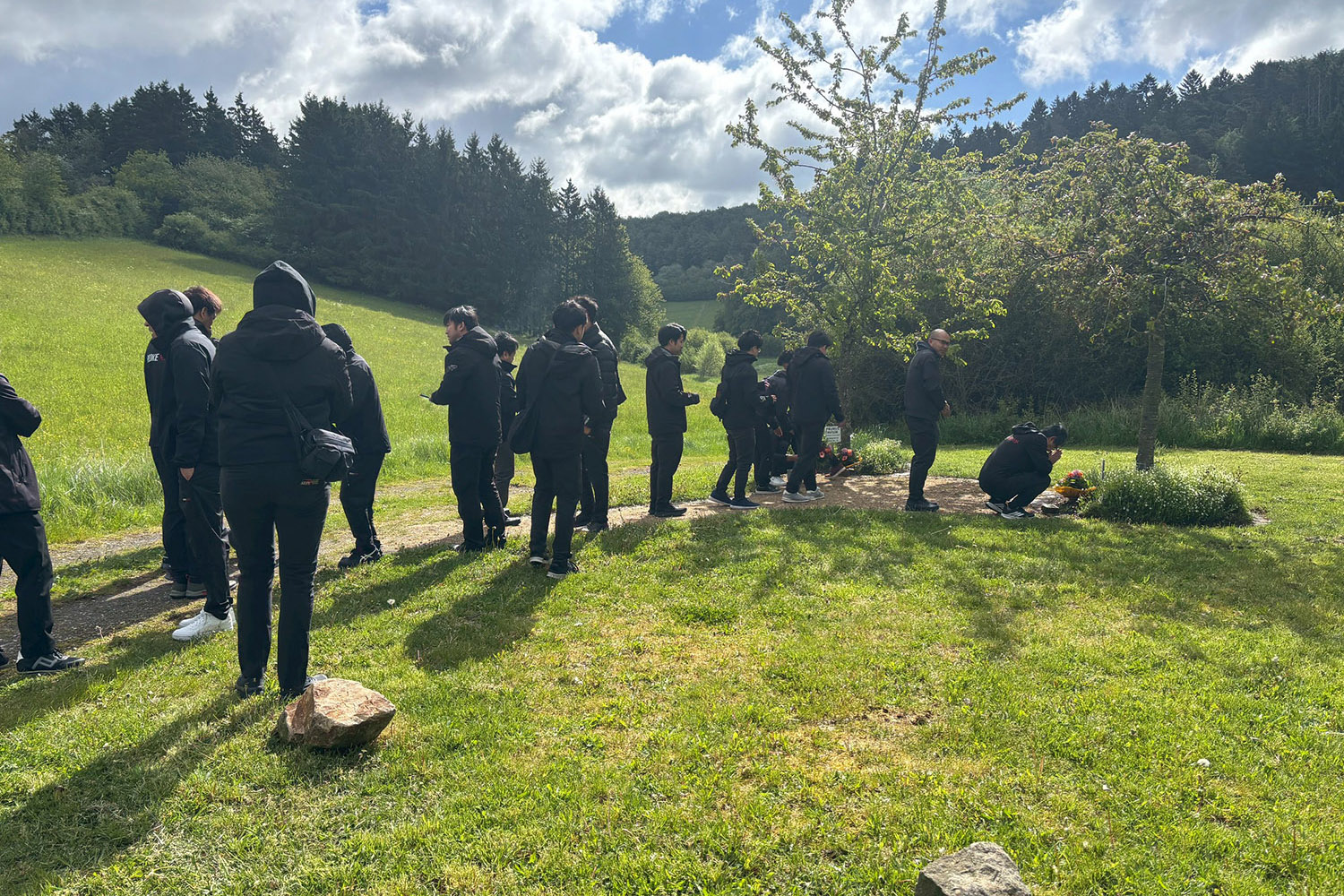
The 2026 24 Hours of Nürburgring, held a month earlier than last year, began with a visit to a small park located along a public road near the Nürburgring. It is the site of two cherry trees, one German and one Japanese, that were planted there. In 2011, the trees were small and had slender trunks, but today they have grown thick, tall, and lush. Here, Morizo and the rest of the team members offered their prayers for safety during the race and shared their individual goals with the late Hiromu Naruse, who paved the way for the team’s activities at the Nürburgring.
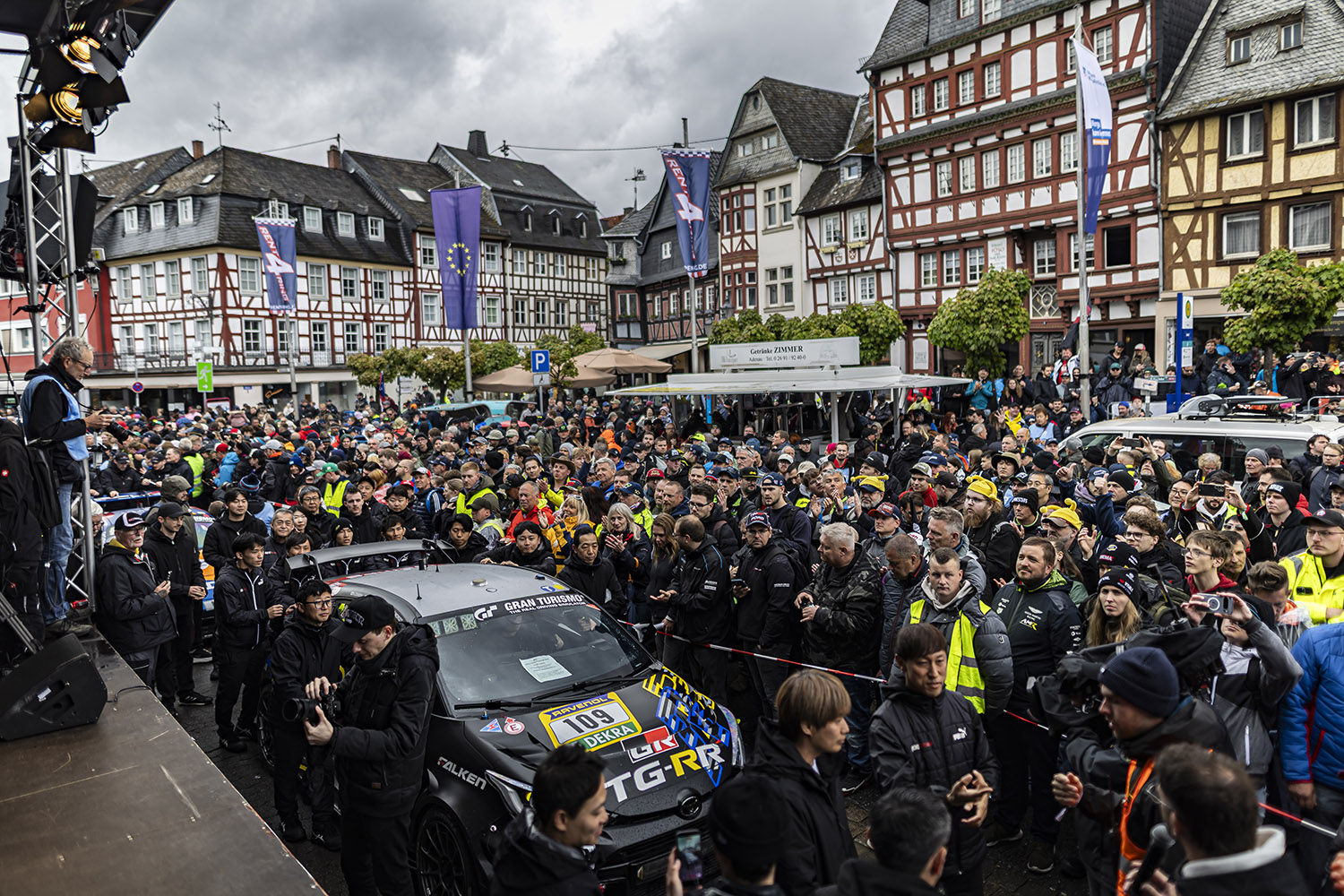
On May 14, the annual Adenauer Racing Day was held in the town of Adenau, about a 10-minute drive from the Nürburgring. This event features a parade of the race cars and drivers competing in the 24 Hours of Nürburgring on public roads. The TGRR team participated again, as they did last year.
Adenau is usually a quiet town with not many people around. However, despite it being the middle of the week and raining heavily, so many people had gathered as the event approached that it became impossible to even move, let alone catch a glimpse of the cars they had come to see, prompting gasps from the team members. In an interview introducing the team, Ishiura conveyed his thoughts to the fans, saying, “We are developing this car for an exciting sports car that will be released in the future, so we really want you to see how it drives.”
On May 15, the first day of qualifying took place amid unseasonably cold spring conditions and Nürburgring weather that changed even more rapidly than usual. The five drivers completed their required two laps during the daytime and evening sessions. Despite forecasts of rain, Morizo drove in dry conditions, living up to his reputation as a “Sunny Boy”. After his run, he spoke with genuine delight and no sign of fatigue, saying: “I’ve only completed four laps so far, but I’m enjoying driving while seeing how the car’s setup changes with every lap. Of course, I intend to drive more laps than last year. I don’t know what the weather will be like, but I’m hoping for conditions that will allow me to make the most of the strengths and advantages that come with 4WD.”
Furthermore, during qualifying, the team was able to compare the GR Yaris under the same conditions as Car No. 110, confirming the evolution of Car No. 109.
Although there were no plans to run on the second day of qualifying on May 16, at the last minute the team decided to run in response to a request from a driver who said, “I want to try pushing the car harder on a dry track,” and they made thorough preparations for the race.
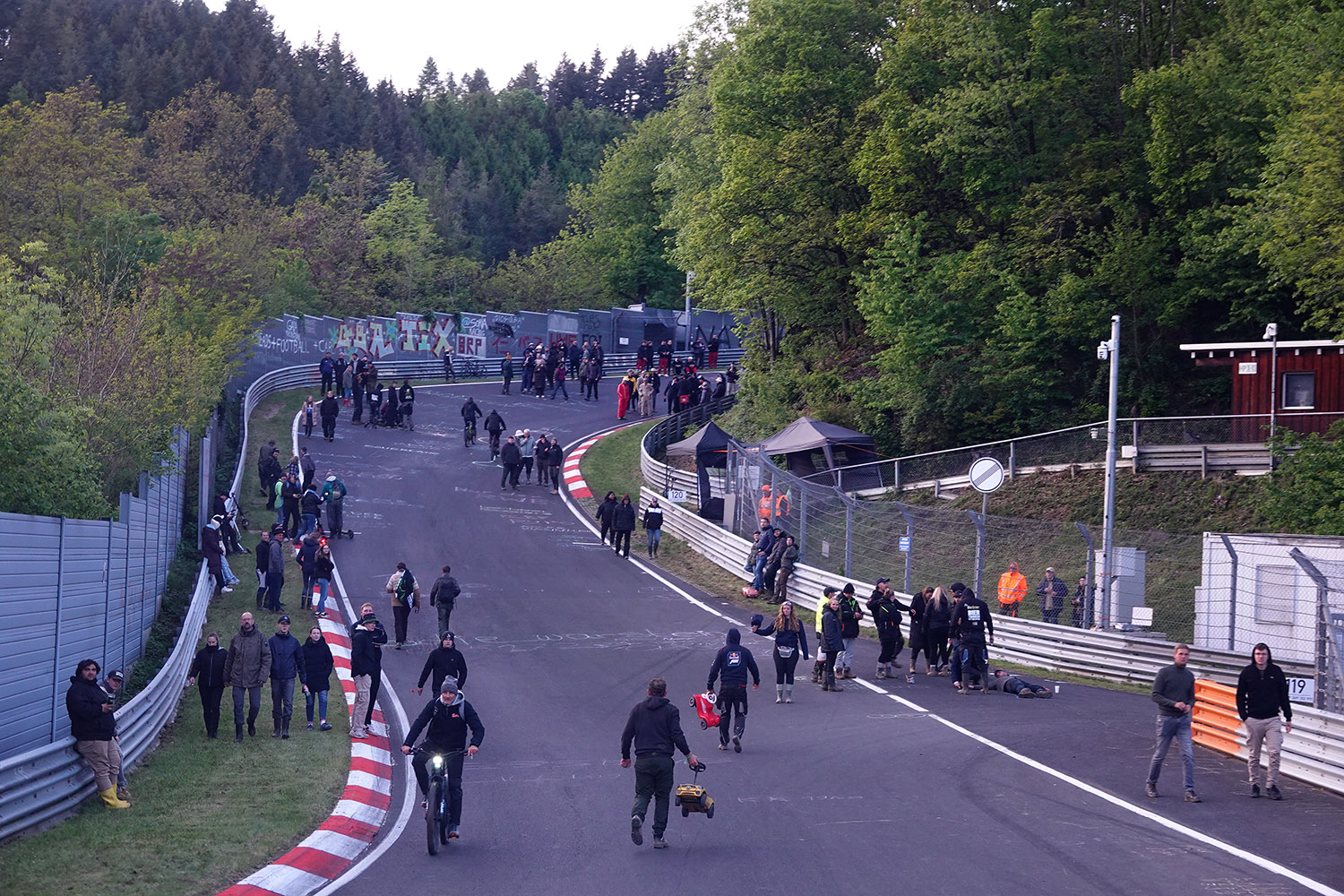
The team participated in a circuit tour that night, driving a lap around the Nürburgring just as they had the previous year. The TGRR drivers and other team members experienced firsthand what makes the Nürburgring so demanding: steep elevation changes, countless corners, and a narrow track. They also got a firsthand sense of the Nürburgring’s racing culture by interacting with fans camping next to the track.
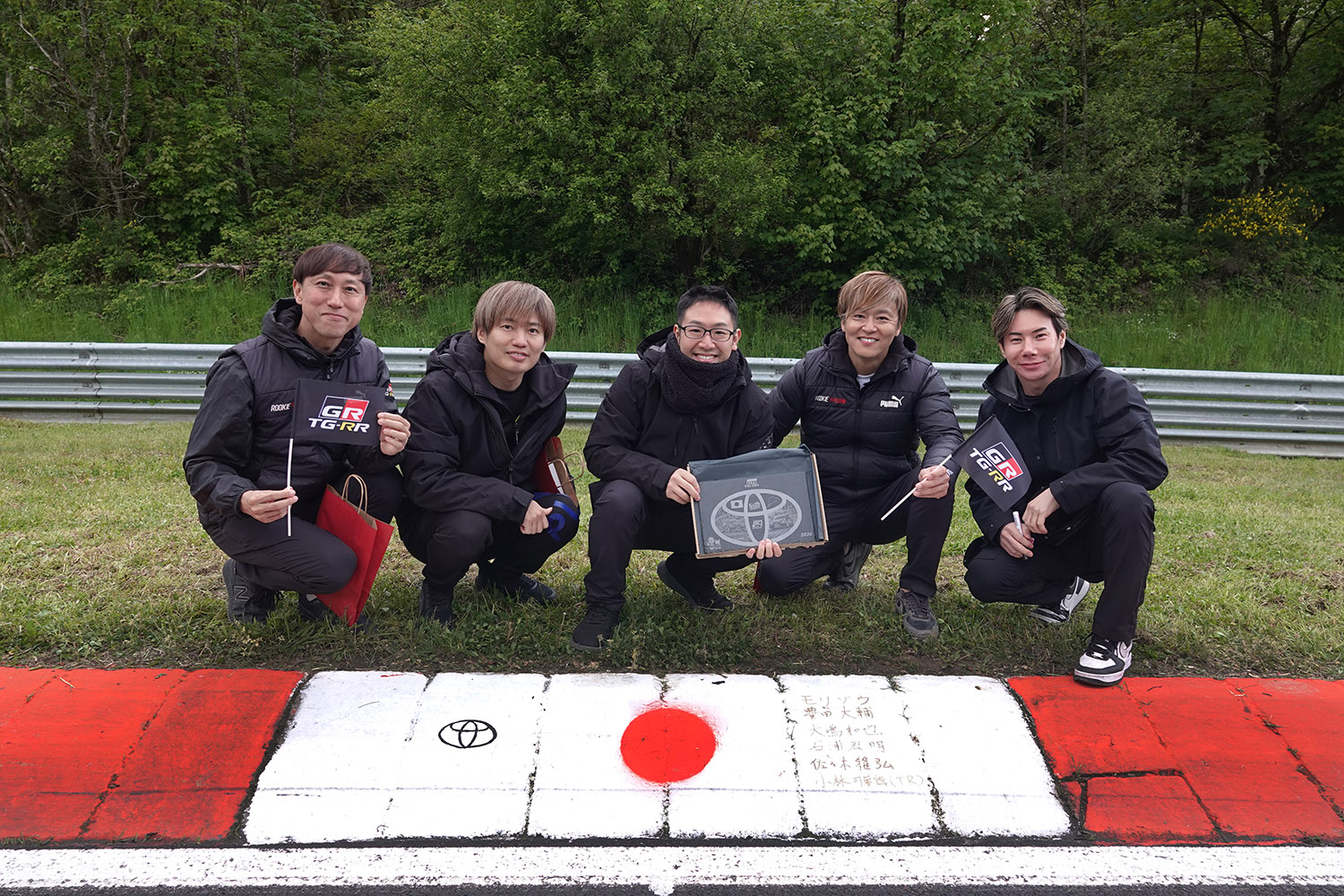
During the team’s morning meeting on race day (May 16), Morizo addressed all members involved in this year’s challenge:
“Last year, we returned to the Nürburgring in the GR Yaris as a return to our roots. This year, we’re continuing that momentum to take on this challenge once again. There’s no need to get swept up in the Nürburgring’s signature exhilaration or its unique atmosphere. Don’t get overly nervous; just focus on executing everything we’ve been working on. From the end of last year’s race until today, the entire team has worked together to make the car, make the people, and build our physical and mental strength. The results of these efforts will be put to the test when the race starts at 3pm. If someone is in trouble, speak up. If there’s something you can do to help, do it. If someone helps you, thank them. It is that simple, thorough dedication that creates a true One Team. The weather is looking uncertain this year, so let’s fight through the 24 hours with health and safety as our absolute priorities.”
This year’s Nürburgring event sold out, partly due to the participation of F1 driver Max Verstappen. Official attendance reached approximately 350,000, an increase of about 70,000 from last year. The grid walk just before the race was even more crowded than usual, making it a struggle for fans to reach the cars they came to see. The TGRR grid brought together a diverse group of people from across different manufacturers, including members of STI and Hyundai, who have been competing at the Nürburgring alongside the team for many years.
Team photos were also taken on the grid. Photographer Noriaki Mitsuhashi captured a shot of Morizo, team GM Toshiyuki Sekiya, and Nürburgring advocate Yasuo Hirata, all three of whom have been involved in this initiative since 2007, taken from the exact same angle as back then. We asked Morizo, “If you hadn’t taken on the Nürburgring back then, what would have become of Toyota?”
“If we hadn’t pursued this initiative, I don’t think we would have been able to weather those difficult times, and I’m not sure the company would even exist today. It was a critical turning point for the company’s very survival. Back then, the automotive industry was dominated by a trend of chasing numbers, where the prevailing view was that ‘a good car is one that sells in large volumes and generates high profits’. I felt a strong sense of unease about this, wondering, ‘Is that really true?’ As a result, there was a period when Toyota was isolated and ignored even by car enthusiasts. Nineteen years have passed since then, and even in today’s era of carbon neutrality, the Nürburgring continues to draw crowds of car enthusiasts. Becoming a Toyota Motor Corporation that doesn’t disappoint such passionate fans is our greatest achievement, and I have nothing but gratitude for the partners who helped make it happen.”
Things don’t always go as planned at the Nürburgring
The 24-hour race began at 3pm. From the start, even as top-tier cars dropped out one after another in the chaos, Car No. 109 continued to run without incident, aside from a crack in the front windshield. Starting driver Ishiura chased down faster competitors through corners showing strong performance.
He pitted just after 4pm, when he handed the wheel over to Morizo, and the car exited the pits led by Car No. 110, driven by Sasaki. Car No. 109 was equipped with an official 24 Hours of Nürburgring camera, broadcasting the smooth driving style inherited from Naruse to the world. Although originally scheduled to drive eight laps like the other drivers, Morizo was caught off guard by the rain that had begun to fall and spun out in the final section of the Nordschleife. The team instructed him to pit early for a tire change, and he handed the wheel over to Daisuke Toyoda after six laps.
After the stint, Sasaki said with a solemn expression: “I deeply regret that my lack of skill in speed control caused Morizo to spin out and gave him a scare.” Morizo, however, took it in stride, remarking: “I just spun around. Slicks have absolutely no grip in wet conditions.” His expression conveyed just how confident he was in the car’s setup.
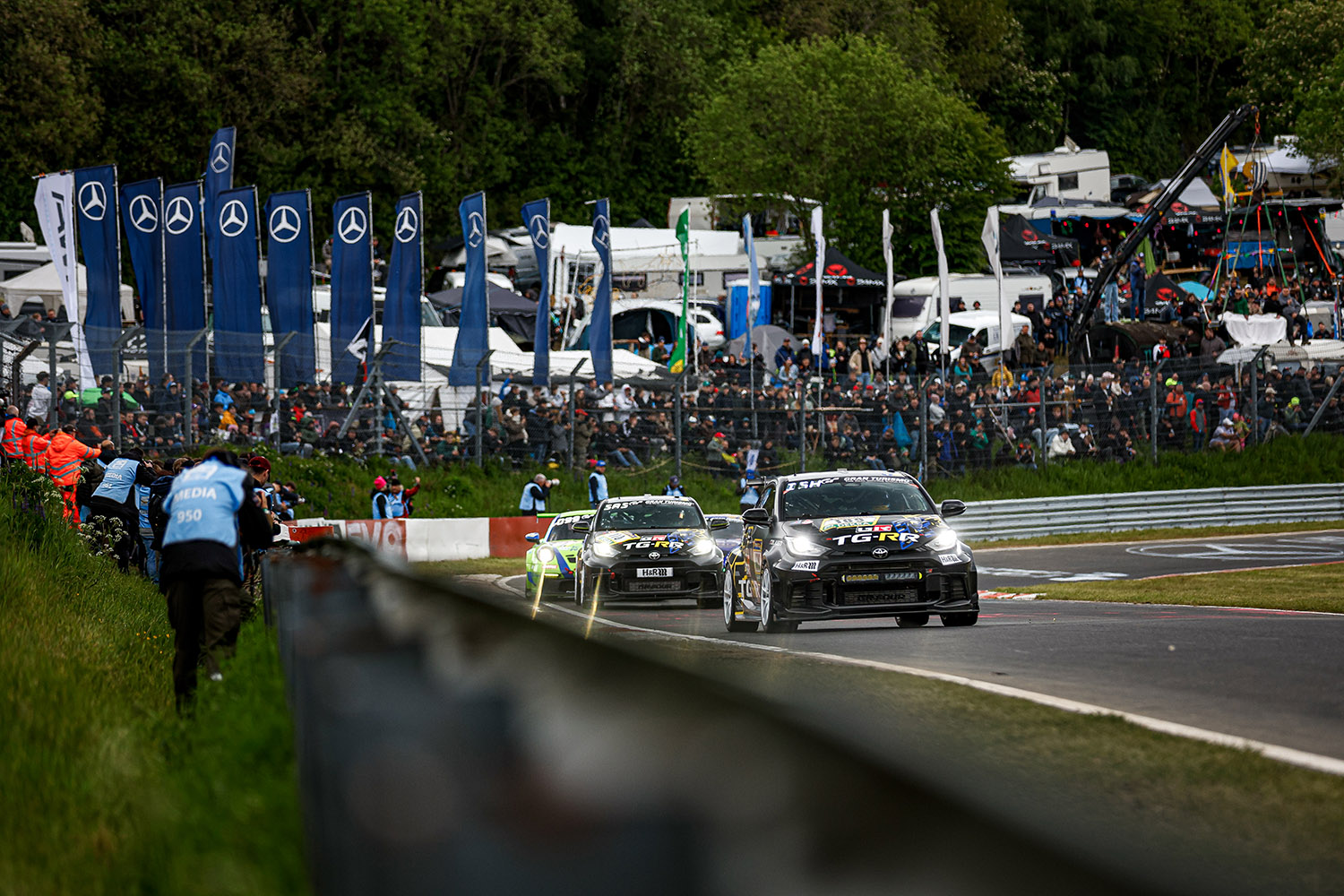
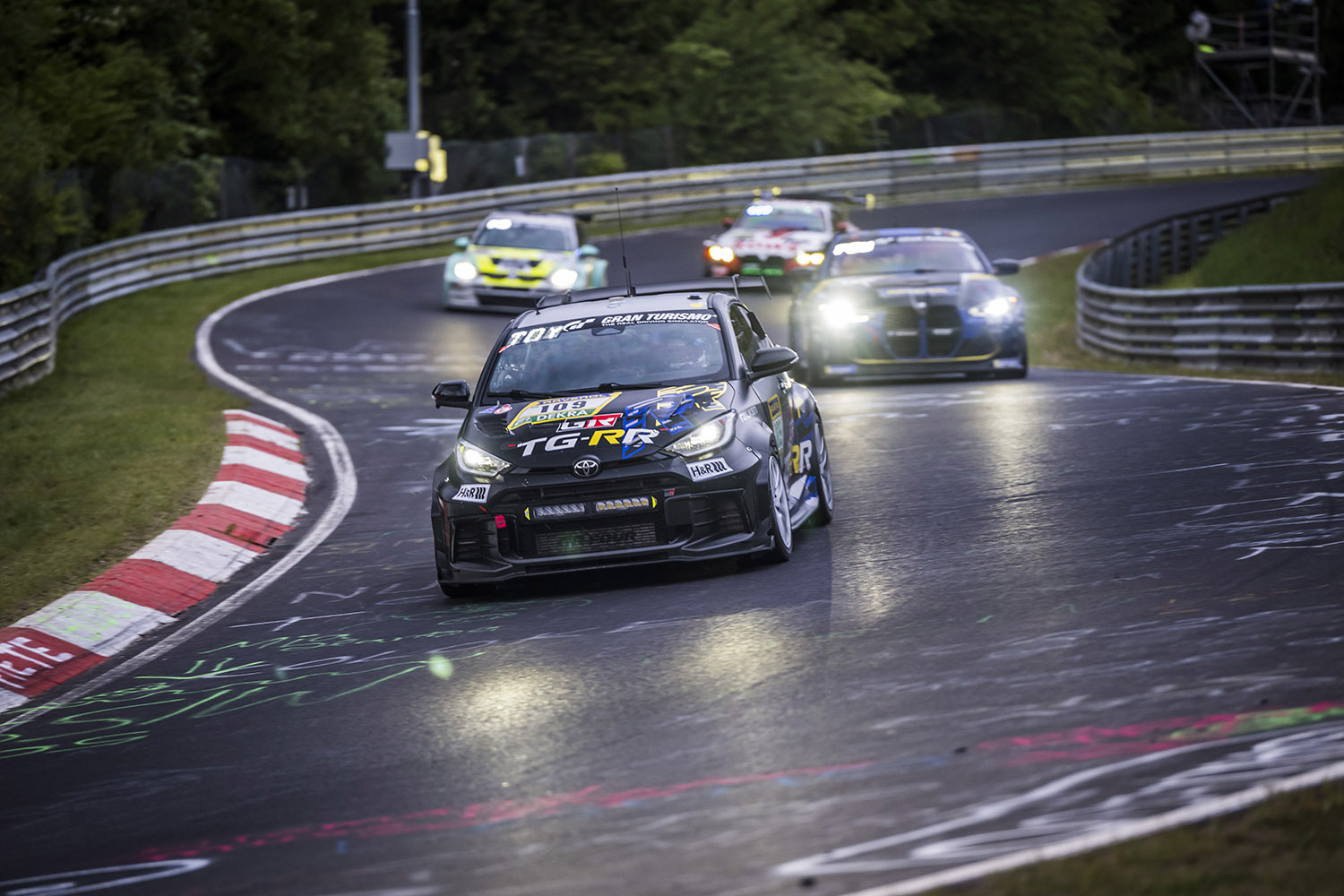
During Daisuke’s stint, tires were changed as required by the rapidly shifting track conditions. Although he reported over the radio that “it’s extremely hot inside the car”, he continued to achieve consistent lap times. However, around 7.30pm during a refueling stop, a problem arose where fuel would not enter the tank. The pit crew grew tense, wondering if it was a major issue, but after investigation, they determined it was a problem with the refueling equipment rather than the car itself, prompting sighs of relief from the team members.
Around 8.30pm, Oshima took over as driver. Just when it seemed the car was running smoothly, a wiper malfunction occurred around 9pm, forcing an emergency pit stop. The mechanics immediately replaced the wiper blades and motor, but it turned out to be an unanticipated problem with an unexpected part. At the Nürburgring, things that normally don’t break, can break.
Late at night, the team encountered a few minor issues such as a steering wheel replacement due to a faulty speed limiter button and a flat tire, but they addressed them promptly. Although late-night hours at the 24 Hours of Nürburgring are notorious for incidents, the cars continued to run smoothly. For dinner, the team served curry, a favorite of Morizo’s. One of the secrets to team unity is “eating from the same pot”. The delicious warmth of the curry in the cold air instantly awoke the team members.
However, as dawn was breaking at 5.20am, just after completing routine maintenance including a brake change and pulling out of the pits, Oshima radioed to report that “the car is vibrating front to back”. Instead of heading out onto the Nordschleife, he returned to the pits. In such a situation, it might be possible to keep driving while managing the problem, but TGRR is competing for development purposes. Safety and reliability cannot be guaranteed unless the cause is identified and the car is fully repaired, so it would not be sent back on track.
“Fix, then take on the challenge again” — toward the next challenge
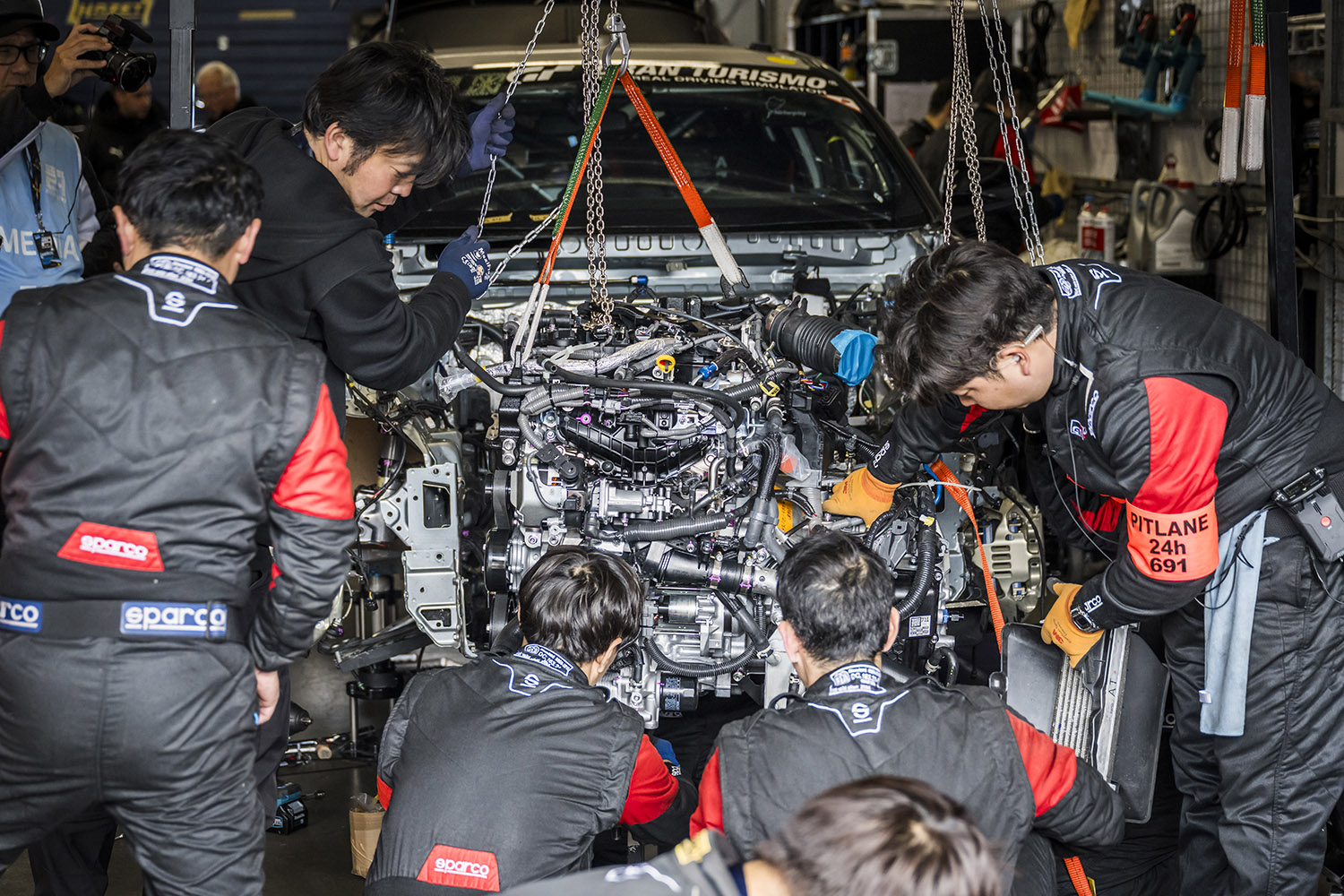
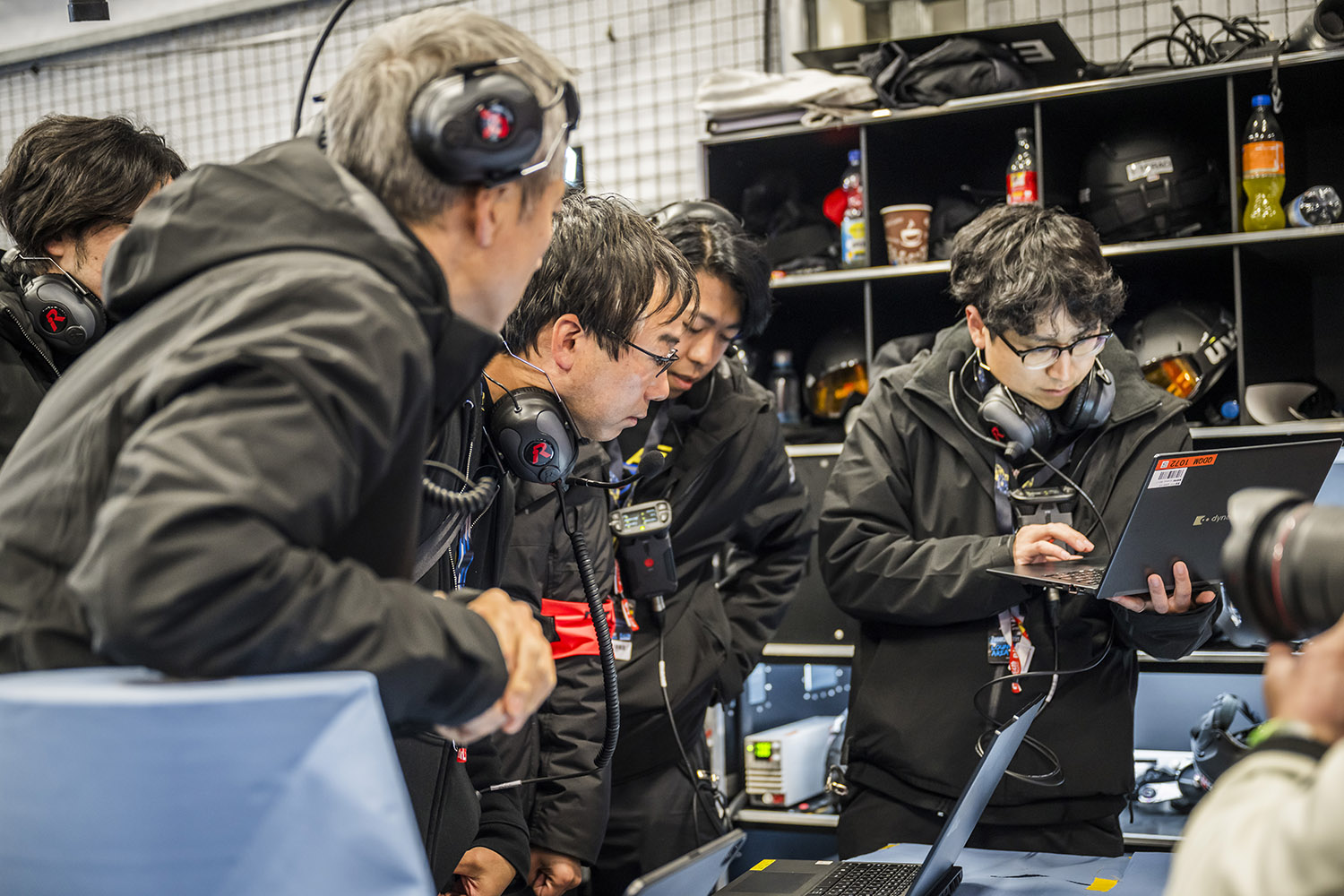
The team first wondered if it was engine-related, but they couldn’t pinpoint the exact cause. They then tried replacing related parts like the brakes and tires, but the problem persisted. About two and a half hours after the problem occurred, Sekiya wondered, “What kind of decision would Mr. Naruse make in a situation like this?” Immediately, he thought, “Mr. Naruse would undoubtedly say with a smile, ‘Are you guys really going to retire?’” So, in order to fix the car and keep it running until the very end without giving up, he made the decision to perform a complete replacement of the engine and driveline, a process that would take time but offer a high degree of certainty.
Morizo, who had rushed to the pits out of concern, gave the go-ahead: “Okay, I get it. Give it a try,” but added, “Take your time, be certain, and prioritize safety.” With that, the team got to work.
At the 24 Hours of Nürburgring, four or five cars share a single pit space. Despite the limited space, equipment, and manpower, the team managed to complete a job that was initially estimated to take over four hours in about three hours.
GR President Tomoya Takahashi reflected: “Time-wise, it was more likely we wouldn’t finish before the end of the race, but Sekiya adamantly declared ‘We’ll fix it in time’. Seeing that look on his face, I truly realized that this was the fruit of the ultimate ‘talent development’ we’ve pursued through our activities at the Nürburgring.” Indeed, Naruse’s teachings have been firmly passed down to his juniors.
The car returned to the track approximately seven hours after the issue occurred, with Morizo taking the wheel for the final stint. Navigating difficult conditions with a mix of dry and wet track sections, he followed Sasaki’s lead, completing eight laps before crossing the finish line.
The result was 77 laps over 24 hours, but since the leader (Car No. 80: Mercedes-AMG GT3 Evo) completed 156 laps, the team fell one lap short of the required number of laps and did not meet the competition’s finishing criteria, resulting in a Did Not Classify (DNC) result.
At the post-race debrief, Morizo addressed the entire team.
“This is the reality of the Nürburgring. Last year, we made a comeback after a six-year hiatus and declared that we would ‘launch our Nürburgring activities with a new structure centered around young members’. While we were blessed with exceptionally favorable conditions last year, that kind of luck doesn’t last. We all need to accept the reality that things don’t always go as planned—and this frustration is what the Nürburgring is all about. I’m now 70 years old, and I don’t know how much longer I can keep going, but this isn’t the end. ROOKIE Racing, GR, and Toyota’s Nürburgring activities will continue with unwavering determination. Even if the accounting department grumbles, or the company refuses to provide funding, seeing it through to the end is the very essence of the Nürburgring. Unlike back then, I have so many partners by my side now. You guys are the best!”
This 24-hour race was filled with frustration, far from the satisfying performance of last year. However, it also taught profound lessons on the fundamental importance of taking on the Nürburgring: keep driving, repairing, and pushing forward.
Hisatomi commented: “We had conducted numerous tests beforehand and thought we had accumulated plenty of data, but unexpected issues arose during the actual race, and I truly realized that this is where the Nürburgring’s true terror lies. To be honest, I’m so frustrated I could cry, but I know I’ll have regrets if I just let things end like this, so I’m determined to make a car that can conquer the Nürburgring and get my revenge someday.”
Sekiya reflected: “This race was an extremely grueling affair, like the toughest races we’ve experienced in the past. As vehicle performance has improved, new challenges emerged that we hadn’t encountered before. However, some of these issues could have been avoided with proper preparation, so there is still plenty of room for improvement moving forward.”
Their words were filled with frustration. As if sensing the emotions in Hisatomi and Sekiya’s remarks, Morizo turned his gaze toward the future.
“This year, driving at the Nürburgring itself was a major goal for me. My leg wasn’t in perfect condition, but I’ve been working to build up my stamina. By completing my run, I gained the confidence that I have the stamina to handle a single stint (eight laps). That’s why my personal desire to drive again next year has grown stronger. However, even stronger than that desire is my desire to take on the challenge with my partners. I want to show our fans the team taking on this challenge together with the partners who fought alongside me this year, in a vehicle that has been further refined and improved.”
Next year marks the 20th anniversary of GR taking on the Nürburgring. The frustration and lessons learned this time will carry over to the next race, helping the team reclaim what was left behind at the Nürburgring. The challenge of making ever-better cars will also continue.


Be the first to comment