
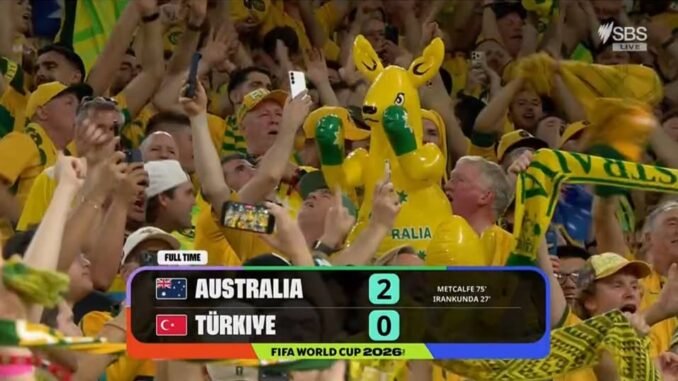
Written off before kick-off, Tony Popovic’s underdogs produced a masterclass in defensive discipline and ruthless counter-attacking to open their World Cup with a famous 2-0 win.
VANCOUVER — They came for a procession and got a wake. Turkey (now Türkiye), the favorite of Group D, arrived at BC Place expecting to brush aside an Australian side most pundits had already penciled in for an early flight home. Instead, they ran headlong into a Socceroos team that defended like its life depended on it, struck twice on the break, and walked off to a standing ovation having recorded only the fifth World Cup victory in the nation’s history.
The final score was Australia 2, Turkey 0, and whilst on paper, it appears an upset, in the flesh, it was something that looked a far more deliberate than that.
This was not a smash-and-grab built on luck and a lucky deflection. It was a plan, executed almost to the letter, by a group of players nobody outside their own dressing room seemed to believe in. By the time Connor Metcalfe’s second goal had nestled into the corner with a quarter of an hour to play, the only people inside the stadium who looked surprised were wearing red.
The Underdog That Bit Back
Tony Popovic has spent his coaching career being doubted, and he wore the satisfaction of this one openly.
“Proud. Proud to be here as head coach,” he said afterwards. “To experience this, put a smile on people’s faces who have travelled so far to support us, and just happy for a group of wonderful young men.”
The numbers tell the story of how improbable the scoreline ought to have been. Türkiye finished with 30 shots and 72% of the ball possession. They had the ball, the territory, and the bigger names, such as Inter’s Hakan Çalhanoglu pulling the strings from deep, Arda Güler buzzing between the lines, Roma’s Zeki Çelik overlapping down the right. What they did not have was a way through. Australia threw their bodies in front of everything, holding formation like glue and making 55 clearances across the ninety minutes, a figure that reads unlike a box score and more like a casualty list.
That kind of performance does not happen by accident. Popovic set his team up to suffer, to absorb, to wait, and then to punish the half-chances that came their way. It was old-fashioned in the best sense: a reminder that a World Cup is won as much with the heart and the head as with the feet.
Patrick Beach: A Star Is Born Between the Posts
If Popovic made one call that defined the night, it was the bravest he could have made. With the experienced former Brighton goalkeeper Mat Ryan available, the head coach instead handed a competitive international debut to 22-year-old Patrick Beach of Melbourne City. On the grandest stage the sport has to offer, against a side bristling with attacking talent, he gambled on youth.
It paid off in spectacular fashion. Beach made eight saves, which is more than any goalkeeper has managed in a single match at the tournament so far, and several of them belonged in a highlight reel of their own. The pick came just three minutes after Australia had taken the lead, when Abdulkerim Bardakci unloaded from distance and Beach somehow clawed the ball onto the post, before celebrating the stop as though he’d scored the winner himself. There were others: a smart save from Güler in the 27th minute, then a superb near-post block to deny Çelik on 72 minutes as Türkiye pushed for a way back into the contest.
For a debutant to keep his nerve, his shape and his concentration through ninety minutes of near-relentless pressure is remarkable. To keep a clean sheet doing it is the stuff of folklore. By full time, his teammates were queuing up to embrace him. A career that began the night with everything to prove ended it with the goalkeeper of the round, and a story he will tell for the rest of his life.
Nestory Irankunda: From a Refugee Camp to the History Books
Every great World Cup night needs its protagonist, and Australia found theirs in a 20-year-old whose journey to Vancouver beggars belief. Nestory Irankunda, the Watford forward born in a refugee camp before his family found a home in Australia, became his country’s youngest-ever World Cup scorer with the goal that broke the deadlock.
It arrived on the counter in the 27th minute, just eighteen seconds after Beach had repelled Türkiye at the other end; the very definition of a sucker punch and none greater has ever been delivered! Irankunda took the ball in stride and finished with the kind of skill and composure that belied both his age and the occasion, sending the Australian end into delirium.
His celebration carried its own meaning. The trademark backflip stayed in the locker; in its place came a punch of the corner flag, a deliberate homage to Tim Cahill, the man whose flagpole jig is woven into Socceroos mythology.
“Timmy Cahill is my biggest inspiration when it comes to football,” Irankunda said. “Him and Lionel Messi. Tim Cahill, Australia’s greatest in my opinion. I just thought if I scored, I’ll do the same as him, and I got to do it.”
He was not done talking, either, and what he said cut to the heart of the night.
“It was extra motivation [being underdogs]. We don’t like to hear people talk bad about us because we are a great team. People underestimate us and we showed them today that we can play. They kept the ball a lot more, but who scored the goals? We scored the goals.”
There is no more eloquent summary of ninety minutes of football than that.
Connor Metcalfe Puts the Result Beyond Doubt
For an hour after Irankunda’s strike, Australia lived on a knife edge. A single goal lead at a World Cup is a fragile thing, and Türkiye’s pressure was mounting. What the Socceroos needed was a second — something to settle the nerves and break their opponents’ belief.
Connor Metcalfe provided it on 75 minutes, and he did it emphatically. Picking up possession in space, the midfielder drove forward and unleashed a low strike from distance that beat the Türkiye goalkeeper at his near corner. It was a goal of real quality, the kind that announces a team is not merely surviving but capable of hurting you whenever it chooses. He wheeled away to celebrate with Jordan Bos, and you could see the relief wash over the Australian bench.
If Irankunda’s goal was the spark, Metcalfe’s was the knockout blow. From that moment the contest, for all Türkiye’s possession, was effectively over.
Souttar and the Backline That Refused to Break
No clean sheet at a World Cup is the work of one man, however heroic the goalkeeper. In front of Beach, Australia’s defenders gave a collective performance of grit and organisation that deserves its own headline. Towering centre-back Harry Souttar was immense in the closing stages, throwing himself into block after block as Türkiye hurled bodies forward in search of a route back. Those 55 clearances were shared across a backline that simply refused to be moved.
It was unglamorous, lung-bursting, last-ditch defending, and exceptionally beautiful in its own way. Turkey’s 30 shots produced nothing because, again and again, there was an Australian leg, head or chest in the way. Discipline like that, in a constant and near perfect formation, sustained for ninety minutes against a side enjoying nearly three-quarters of the ball, is the mark of a team that knew exactly what it was doing.
What It Means
The win lifts Australia to three points and second place in Group D, behind only the United States on goal difference and ahead of both Türkiye and Paraguay. Suddenly a group that looked daunting on paper has a very different complexion. Popovic’s men will take six days to recover before the showpiece event against the hosts, the USA, in Seattle, with top spot on the line. Paraguay, in Santa Clara, awaits after that.
There is a long way to go, and one ‘roo does not a pack make! But for a side that nobody fancied, that arrived as makeweights in someone else’s group, this was a statement of intent delivered with both fists. The experts had their say before kick-off. In Vancouver, the Socceroos had the final word … and it made for the sweetest victory!
As Irankunda put it, with the directness of a man who has just proved a doubting world wrong: who scored the goals? Australia did. And on this evidence, they are not finished yet.
Be the first to comment