

Tim Tszyu produced one of the most significant victories of his career on 26 July, defeating former unified welterweight champion Errol Spence Jr by unanimous decision after twelve demanding rounds at Sydney’s Afterpay Arena. For Tszyu, the result completed an important stage in the reconstruction of a career that had recently appeared in jeopardy. For Spence, it brought the final chapter of an exceptional career.
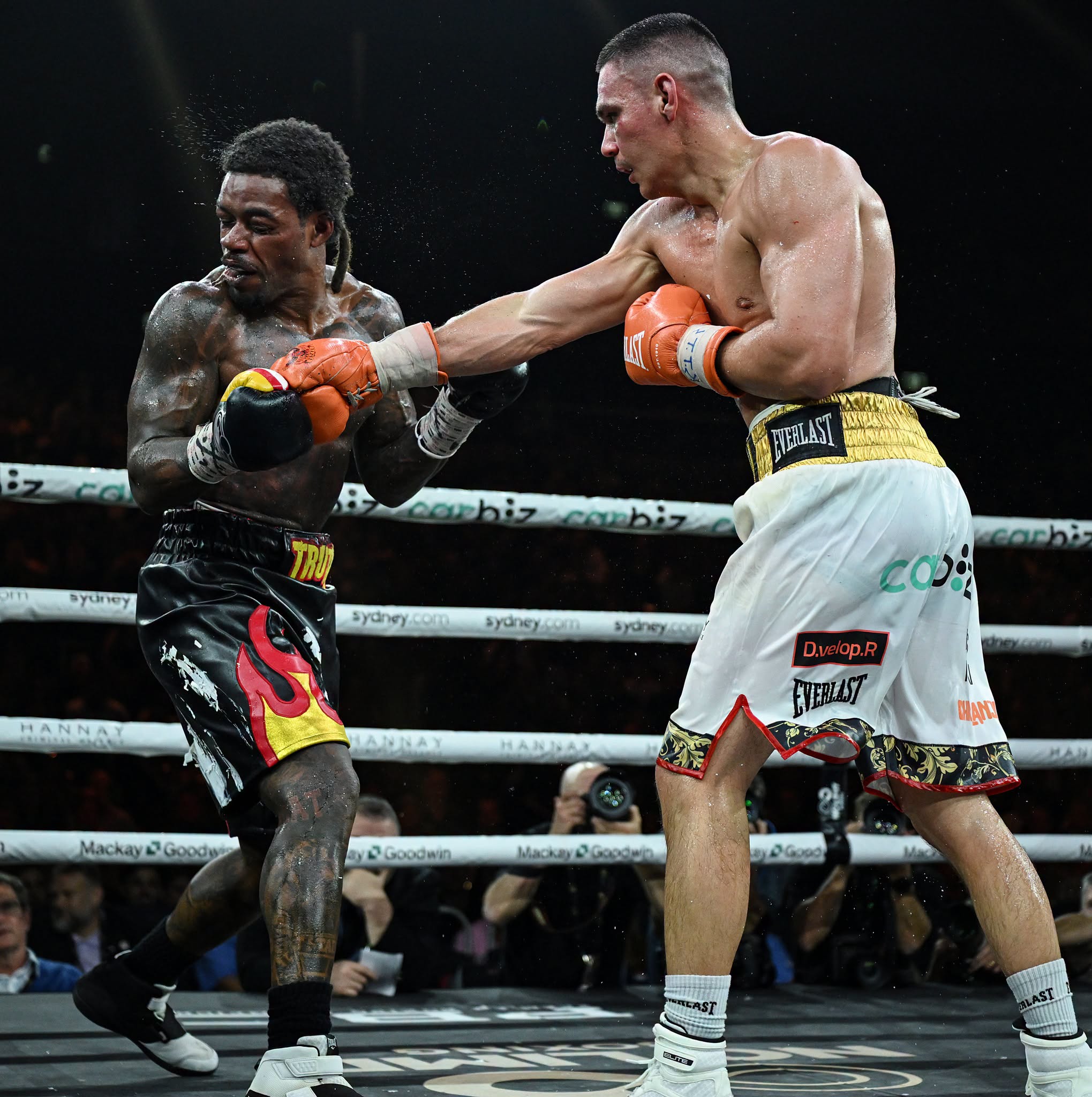
Tim Tszyu entered the ring at Sydney Olympic Park carrying more than the immediate expectations surrounding a major international contest. He was fighting to restore his position in world boxing, validate his move into the middleweight division and demonstrate that the punishment and disappointment of recent defeats had not permanently diminished him. Twelve rounds later, after systematically overcoming Errol Spence Jr’s early resistance, Tszyu had secured a decisive unanimous decision and placed himself back within reach of another world championship opportunity.
The judges returned scores of 118–110, 117–111 and 117–111, each accurately reflecting Tszyu’s increasing control as the contest developed. Spence remained competitive during the opening phase and produced occasional reminders of the intelligence and technical quality that had made him one of the finest welterweights of his generation. However, he could not maintain the physical output required to prevent Tszyu from taking command. By the second half of the fight, the Australian’s greater strength, sustained body attack and increasingly authoritative right hand had established a clear separation between them.
The bout had originally been discussed at a catchweight of 158 pounds before being moved during fight week to the full middleweight limit of 160 pounds. That late adjustment appeared more likely to benefit Spence, who was returning after three years away and no longer attempting to force his body down to the welterweight limit at which he had built his reputation. In practice, however, the additional weight underlined Tszyu’s natural physical advantage. He looked comfortable in the division, absorbed Spence’s punches without losing his structure and became increasingly capable of moving the American backwards.
There was considerable uncertainty surrounding both men before the opening bell. Tszyu had rebuilt some momentum through consecutive victories, but the damage inflicted during his turbulent period at super welterweight remained impossible to ignore. His first professional defeat came against Sebastian Fundora in March 2024, when an accidental collision with Fundora’s elbow opened a severe wound on Tszyu’s forehead. With his vision repeatedly obscured by blood, he completed the twelve rounds but lost a split decision and his WBO championship.
The subsequent stoppage defeat against Bakhram Murtazaliev was more alarming. Tszyu was dropped repeatedly and stopped in the third round after attempting to answer the Russian champion’s power with unrestrained aggression. A rematch defeat to Fundora in July 2025 added another difficult episode to a period in which Tszyu’s resilience was repeatedly tested and his standing among the world’s leading fighters began to recede.
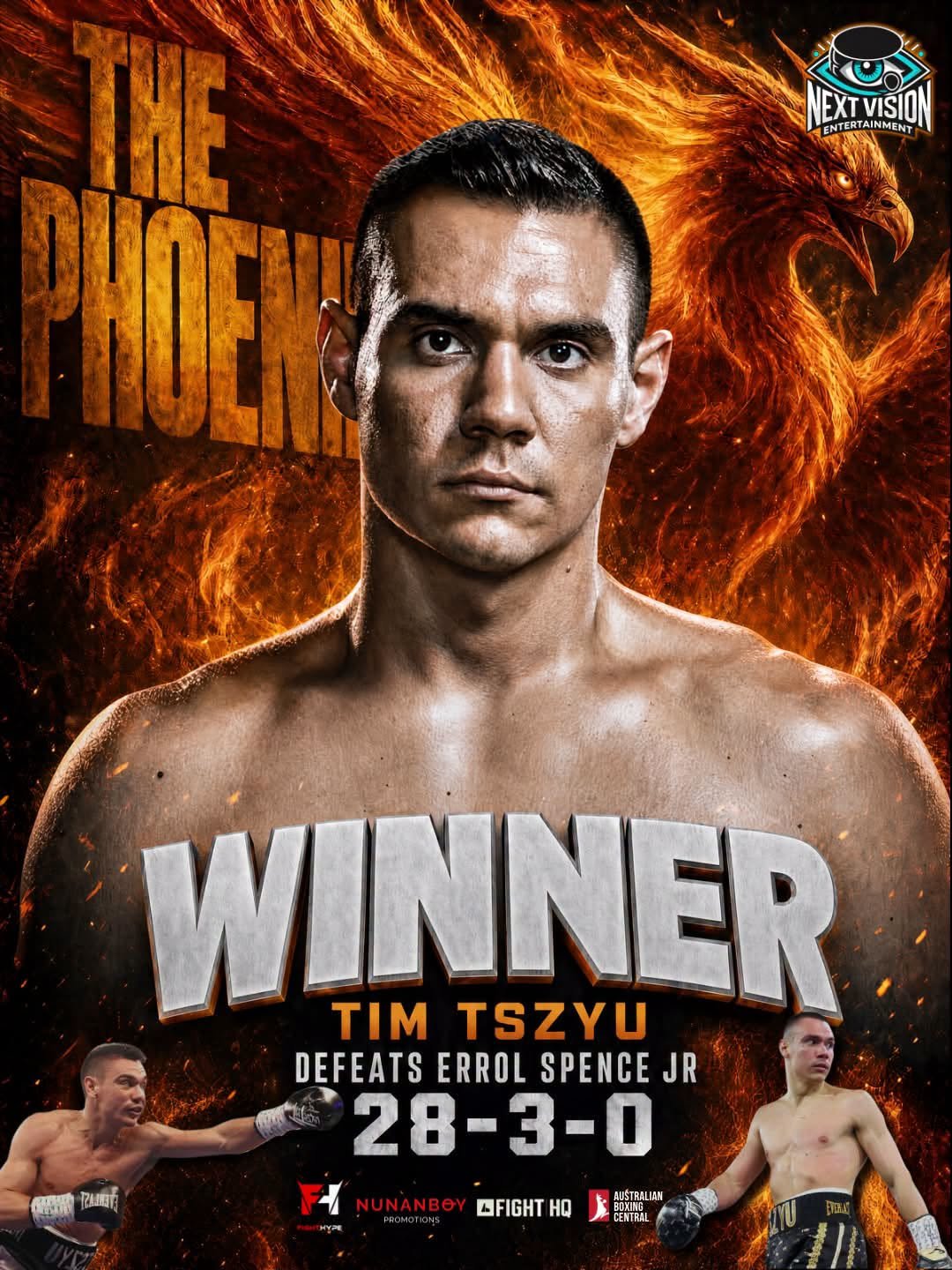
His eventual adoption of “The Phoenix” as a new ring identity carried an obvious message. Tszyu wanted his return to be defined by reconstruction rather than damage, although such a transformation needed to be demonstrated against an opponent of genuine international stature. Spence supplied that opportunity, even if the version of the American who arrived in Sydney remained one of the fight’s great uncertainties.
Spence had not competed since his comprehensive ninth round stoppage defeat against Terence Crawford in July 2023. Before that loss, he had won all 28 of his professional bouts and unified the IBF, WBC and WBA welterweight championships. His victories over Kell Brook, Shawn Porter, Danny Garcia, Yordenis Ugás and Mikey Garcia had established him as a remarkably complete pressure fighter who could control opponents through his jab, physical strength, body punching and relentless accumulation of work.
His achievements were made more remarkable by the adversity he encountered outside the ring. Spence survived a serious car accident in Dallas in October 2019 and later underwent surgery to repair a detached retina, forcing the cancellation of a proposed fight against Manny Pacquiao in 2021. He returned from both episodes to compete successfully at world championship level, but those interruptions, combined with his inactivity following the Crawford defeat, raised legitimate questions about how much of his former athletic capacity remained.
Spence’s absence lasted 1,093 days. No amount of training could completely replicate the timing, balance and instinct required in a competitive ring, especially against a younger and naturally larger opponent who had remained active. The 36 year old American nevertheless began with purpose. Operating from his familiar southpaw stance, he attempted to establish his jab, move laterally and find openings for the straight left hand.
Tszyu immediately showed that he was prepared to apply pressure without abandoning caution. He did not charge forward with the reckless urgency that had contributed to his defeat against Murtazaliev. Instead, he advanced behind a controlled guard, watched Spence’s movement and looked for opportunities to land his right hand over or around the southpaw jab.
The Australian landed one of the opening round’s most significant punches when a powerful right hand disrupted Spence’s balance. It was an early indication that Spence could be affected whenever Tszyu connected cleanly, although the American responded by increasing his activity and producing some of his best work during the next several rounds.
Spence’s early success came through timing and experience. He found openings with the straight left, touched Tszyu’s body and occasionally caused the Australian to reset by varying the rhythm of his combinations. His technique remained recognisable, but his physical stability was less convincing. He frequently leaned too far over his front leg while punching and sometimes required an additional movement to restore his balance. Against a fighter with Tszyu’s right hand, those moments created considerable danger.
The opening five rounds contained enough competitive exchanges to suggest the outcome remained uncertain. Spence was busier in several passages, while Tszyu landed the heavier individual punches. The Australian’s composure was particularly significant. He appeared willing to concede brief periods of activity while studying Spence’s reactions, confident that the physical demands of the contest would eventually favour him.
That assessment proved correct. From the sixth round onwards, Tszyu began to impose himself with far greater consistency. Under the direction of new trainer Jeff Fenech, he increased the pressure and focused more heavily on Spence’s body. The adjustment reduced the American’s mobility, weakened the effectiveness of his jab and made it increasingly difficult for him to create the distance required for clean counterpunching.
Tszyu’s body attack became the central tactical feature of the contest. He drove punches beneath Spence’s elbows, worked around the guard and forced the former champion to absorb shots while attempting to move away. Each individual punch contributed to the decline in Spence’s output. His movement became more laborious, his punches arrived with less authority and his defensive reactions slowed.
The significance of Fenech’s influence was evident in Tszyu’s patience. Fenech, a three division world champion and one of the most accomplished fighters Australia has produced, encouraged him to close the distance and make the fight more physically demanding. Tszyu followed those instructions without discarding his defensive responsibilities. He pressured Spence while remaining alert to the straight left and resisted the temptation to pursue a dramatic finish whenever the American appeared vulnerable.
Tszyu also began landing his right hand with increasing regularity. Some arrived as leads when Spence was waiting to counter, while others were thrown over the jab or delivered after the Australian had forced him towards the ropes. Spence was visibly shaken on several occasions, although he never went down and continued to answer with enough determination to prevent the referee from becoming involved.
The statistics confirmed the extent of Tszyu’s second half superiority. According to CompuBox figures reported after the fight, Tszyu landed 190 total punches compared with Spence’s 157. More revealing was his advantage in power punches across the final seven rounds, during which he landed 117 compared with Spence’s 59. That differential captured the pattern of a contest in which Spence remained willing but became progressively less able to withstand Tszyu’s strength and accumulated pressure.
Spence summoned a determined response in the eleventh round. He increased his output and briefly disrupted Tszyu’s rhythm, demonstrating the competitive pride that had carried him through a championship career. It was a spirited intervention, although it could not alter the direction of the fight. Tszyu remained composed, absorbed what came back and entered the final round with a commanding advantage.
By then, Spence appeared exhausted. Three years of inactivity, the unfamiliarity of fighting at middleweight and Tszyu’s sustained body work had exacted their price. Tszyu landed another forceful punch in the twelfth that sent Spence heavily into the ropes before he rebounded towards the centre of the ring. The Australian chose not to abandon his discipline in pursuit of a stoppage, completing the fight securely rather than exposing himself to an unnecessary counter.
When the final bell sounded, there was little doubt about the result. Tszyu had won through superior physicality, effective tactical adjustment and the ability to sustain his work after Spence’s early challenge had begun to fade. The breadth of the official scorecards was justified, although the numbers alone did not fully acknowledge the American’s contribution. Spence competed with courage, produced moments of technical quality and completed twelve rounds against a strong middleweight after almost three years outside the ring.
For Tszyu, the victory carried an importance extending beyond the reputation of his opponent. He had defeated an internationally recognised former champion while demonstrating a level of control that had been absent during the most damaging period of his career. He did not require chaos to generate offence, nor did he allow aggression to overwhelm judgement. His pressure was calculated, his body punching served a deliberate purpose and his composure remained intact throughout the fight.
Tszyu acknowledged afterwards that he had experienced sleepless nights while considering the scale of the challenge. He described Spence as a legend and said that defeating him meant more personally than winning another world title. He also confirmed that middleweight would be his new division, explaining that he felt strong at the weight and naming WBA champion Erislandy Lara among the opponents he would be interested in facing.
There are still questions that one victory cannot answer. Spence was a celebrated opponent, although he was also 36 years old, returning after an extraordinarily long absence and competing above the division in which he achieved his greatest success. Tszyu’s performance restored his credibility, but the contemporary middleweight elite will present different tactical and physical problems. A title fight against Lara, or another leading contender, would provide a more definitive measure of his championship prospects at 160 pounds.
Even with those qualifications, the victory should not be diminished. Tszyu faced an opponent with elite experience, managed the difficult opening rounds and then took control through intelligent, sustained pressure. The fight represented genuine progression from the version of Tszyu who had pursued Murtazaliev without sufficient regard for defence and paid an immediate, punishing price.
The emotional conclusion belonged to Spence. Shortly after the decision was announced, the former champion confirmed that he intended to retire. He spoke with gratitude rather than bitterness, explaining that he was financially secure, surrounded by his family and able to leave boxing with his health and mental faculties intact.
“It has been a great journey for myself, but it’s time to be with my family and live that family life,” Spence said after the fight. In a later interview, he admitted that the twelve rounds had felt unusually long following his extended absence, while expressing satisfaction that he had completed the contest. His family had also encouraged him to stop, bringing a degree of certainty to a decision that fighters often find extraordinarily difficult to make.
If the decision remains final, Spence leaves with a professional record of 28 victories and two defeats, including 22 wins by knockout. His final two appearances ended in defeat, but they should not distort the quality of the career that preceded them. At his peak, Spence was an exceptional welterweight who combined technical accuracy with physical pressure and showed a willingness to meet the division’s strongest available opposition.
The post fight embrace between the two men provided an appropriate conclusion. The tension and provocation of fight week were replaced by recognition of what each had endured. Spence had returned to discover whether a final competitive chapter remained available to him. Tszyu had needed to prove that his own story still contained meaningful victories.
Sydney supplied answers for both. Spence had enough remaining to compete with courage, but not enough to recover the championship form that once made him one of boxing’s most feared operators. Tszyu, meanwhile, showed that his setbacks had not removed his ambition or his capacity to perform on a major stage.
The Phoenix identity will face more severe examinations if Tszyu proceeds towards a middleweight championship. On this night, however, the symbolism was earned. Tim Tszyu had emerged from the most difficult period of his professional life, defeated one of the most distinguished fighters of his generation and reclaimed a place in boxing’s international conversation. As one career reached its dignified conclusion, another was given the opportunity to rise again.

Be the first to comment